
X-RAY FLUORESCENCE ANALYSIS OF OBSIDIAN AND OTHER ARCHAEOLOGICAL MATERIALS
The energy-dispersive (EDXRF) x-ray fluorescence laboratory provides access to analyses of archaeological and source standard obsidian and other volcanic rocks on a per-sample basis under the direction of Steven Shackley, who has worked on various archaeological projects worldwide, particularly in the greater North American Southwest for over 40 years. This laboratory is the daughter lab of work by Shackley at Arizona State University, and then the University of California, Berkeley. I would like to stress that the research is focused on analyses of archaeological obsidian from the greater American Southwest including southern California, Baja California, Arizona, New Mexico, Sonora and Chihuahua. I feel strongly, that while other labs can provide adequate instrumental analyses from archaeological material in this region, my lab can provide more reliable provenance assignments and archeological interpretation given our direct experience with the sources and archaeology in the field. I am frequently in the field locating, mapping, and documenting newly discovered sources of archeological obsidian, dacite, and other volcanic rocks.
The Quant'X Energy-Dispersive X-Ray Fluorescence Spectrometer (EDXRF)
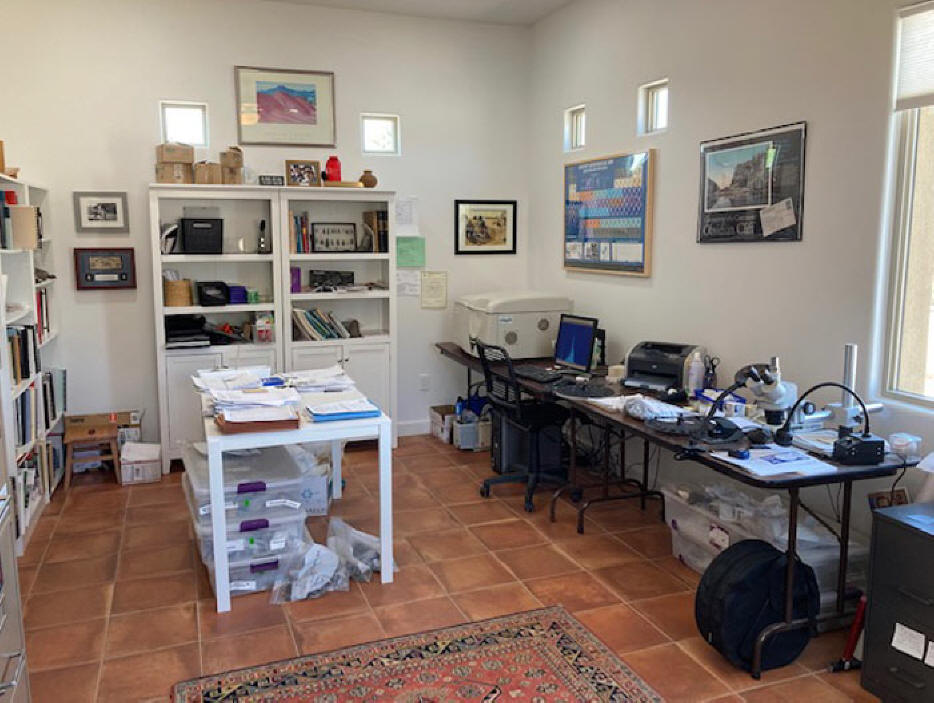
The ThermoScientific Quant'X EDXRF spectrometer is particularly adapted to non-destructive analyses of archaeological obsidian, and other volcanic rocks. The lab is a 360 sq. ft. facility housing the Quant'X EDXRF laboratory spectrometer, sample preparation, four computer platforms, microscopy, and the source standard library for obsidian and dacite sources worldwide, including all the rock sources in the North American Southwest collected over the last 40 years. The laboratory is powered by 6.3 kW rooftop solar completely isolated from the rest of the building circuitry.
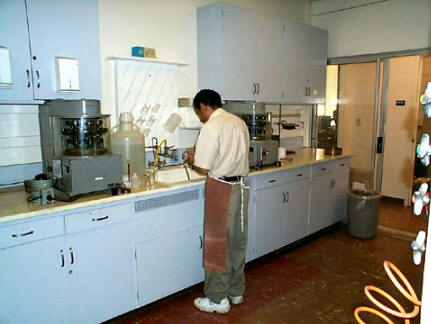
Agazi Negash (former Post-Doc) in sample prep lab at Berkeley working on the Ethiopian obsidian samples.
We can provide letter or comprehensive reports and strongly encourage you to consult with us during your planning stages to discuss sampling issues. We have wide experience in all spatial and temporal contexts as witnessed by the selected bibliography provided. We can provide quantitative non-destructive elemental analyses of obsidian, other volcanic rocks, secondary siliceous sediments (cherts and chalcedony), and ceramics usually within two to three weeks, often sooner. Results sent through e-mail immediately after completion. Most laboratory reports are curated at the completely searchable https://escholarship.org/ University of California open access website, unless otherwise requested, available to all.
Many researchers from a variety of organizations have used the Berkeley EDXRF facilities for the analysis of archaeological materials including, the U.S. Forest Service, the Bureau of Land Management, US National Park Service, the Laboratory of Archaeology, Museum of New Mexico, the Instituto Nacional de Antropología e Historia (INAH) at a variety of offices in northern Mexico, the Institute of Archaeology and Ethnography, Siberian Branch of the Russian Academy of Science, and a large variety of Cultural Resource Management firms, mainly in the Southwest and southern California.
Please consider our instrumental facilities for your analytical needs. If you have any questions at all, please feel free to contact us by mail, phone, or Internet.
Non-destructive trace elements analyzed: Ti, Mn, Fe, Co, Ni, Cu, Zn, Ga, Rb, Sr, Y, Zr, Pb, Th in parts per million (ppm) ratioed to the Rayleigh scatter. Barium (Ba) and cerium (Ce) is measured when necessary, or at request for $5.00 more per sample. Sample sizes down to 7 mm in largest dimension. Call if many samples < 7 mm in largest dimension.
Non-destructive oxide analyses (fundmental parameter-theoretical) for SiO2, P2O5, Al2O3, CaO, Fe2O3, K2O, MgO, MnO, Na2O, TiO2, available non-destructively for rocks. Best if samples > 20 mm in largest dimension. See example in the Journal of Archaeological Science paper on northern New Mexico dacite here, and New Mexico Geology paper on Bearhead Rhyolite here.
Non-destructive metal fundamental parameter (theoretical) analyses (coins, copper artifacts, other metal artifacts) for Mn, Fe, Co, Ni, Cu, Zn, As, Mo, Ag, Sn, Sb, Au, Pb, Bi.
M. Steven Shackley, Ph.D., Director
TELEPHONE: 510-393-3931
Secure shipping Address:
M. Steven Shackley
Geoarchaeological XRF Laboratory
8100 Wyoming Blvd NE, Unit M4-158
Albuquerque, NM 87113-1946 USA
Receives USPS, UPS, FedEx, and DHL packages
Note: These are commercial prices. The proceeds from these projects are used to fund students, and provide supplies for continuing field and lab work. Geological source samples are generally analyzed at no cost. Please call before field sampling, if possible.
We
intend to continue to provide integrative and synthetic reports, particularly to
the Southwestern audience.
This is still one of the best bargains in archaeometry. With the
increasing cost of mailing and shipping, I have to add mailing fees to each
project.
1-20 = $20.00 per sample
21-n = $18.00 per sample
NOTE TO NEW MEXICO CLIENTS: All invoices will include the gross receipts tax (GRT) for the GRT at your location that I am required to collect for the State of New Mexico unless the client has an NTTC.
 Let me see the Sample Submission Form!
This page maintained by Steve Shackley (shackley@berkeley.edu).
Revised: Friday, 12 June 2026


 Back to top of page
  Back to EDXRF
Lab Home Page
Back to EDXRF
Lab Home Page